
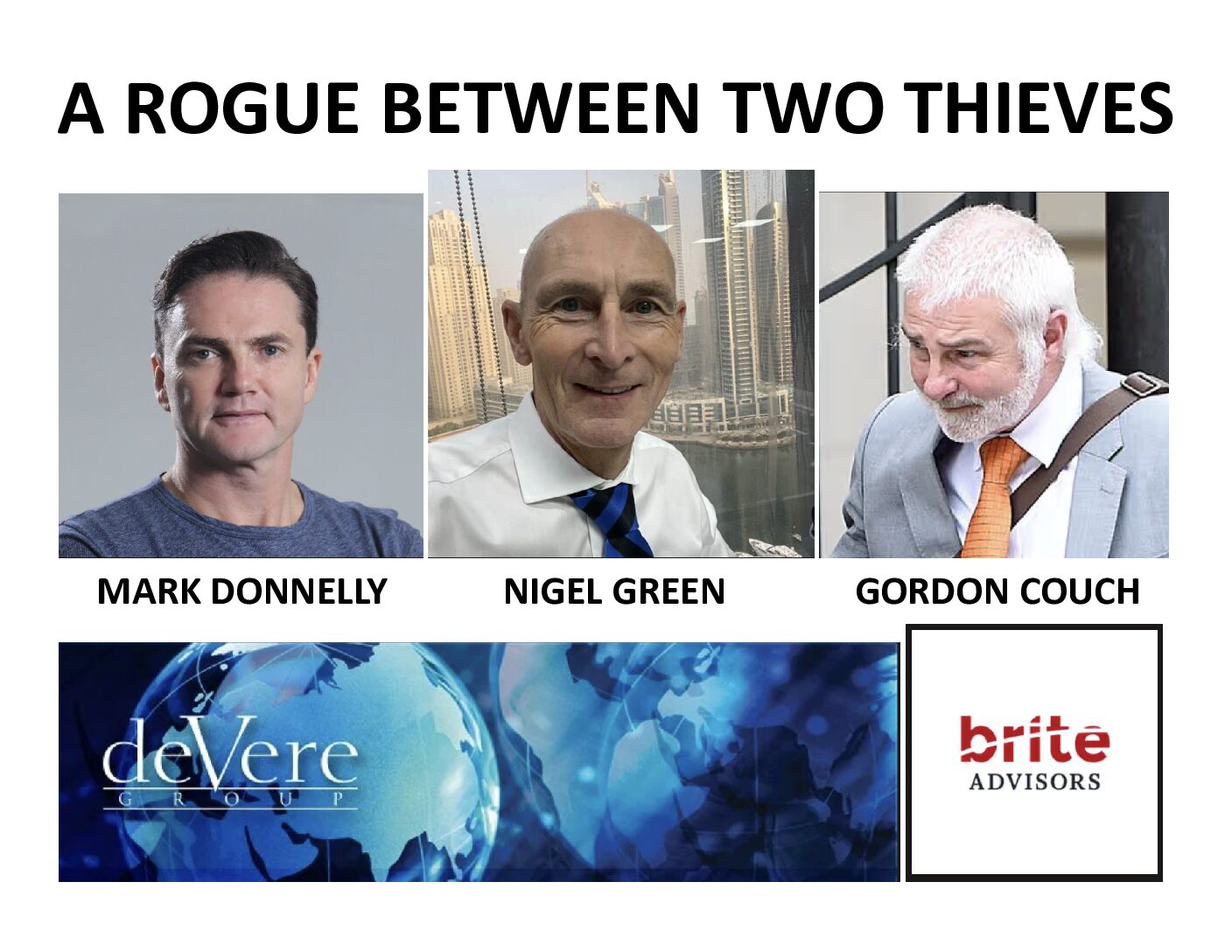
Nigel Green of deVere and Fraudster Mark Donnelly of Brite Advisors
DONNELLY, GREEN & COUCH. Sounds like a dodgy firm of solicitors like Sue, Grabbit & Run. Instead it is three (alleged) independent financial advisers inextricably linked to the Brite Advisors fraud and the GFS pension disaster in Hong Kong.
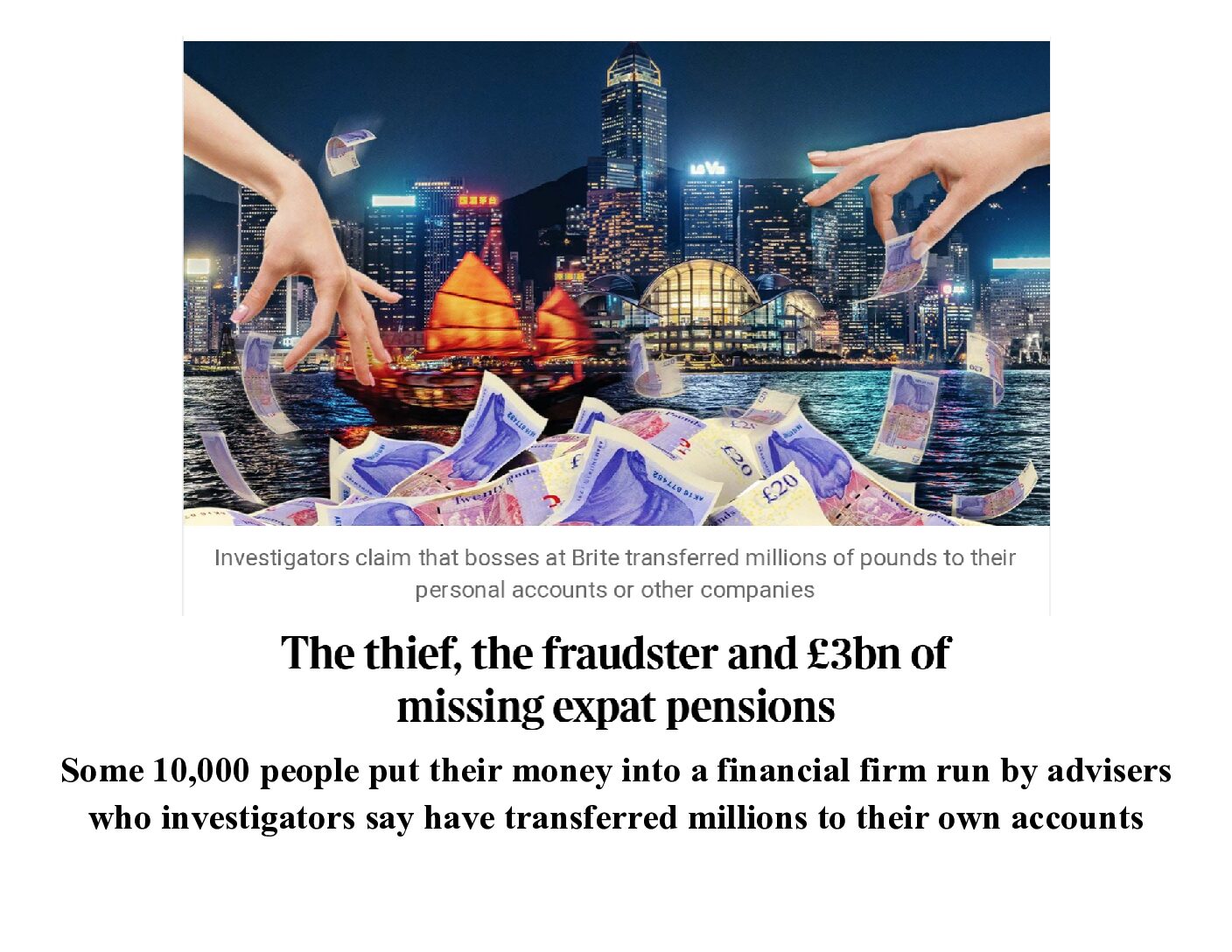
Financial journalist Ali Hussain captured the essence of Mark Donnelly’s massive Brite Advisors fraud in the 2024 Sunday Times article “The thief, the fraudster and £3bn of missing expat pensions”.
ALI HUSSAIN’S SUNDAY TIMES ARTICLE EXPOSING THE BRITE ADVISORS FRAUD:
“What happened? The savers are 10,000 victims of a network of financial advisers working for a firm called Brite Advisory Group, run by convicted fraudster Mark Donnelly. Donnelly’s right-hand man was a financial adviser (Gordon Couch) who fled the UK after duping a 91-year-old dementia sufferer out of £170,000.”
“Investigators claim that instead of investing savers’ money in pensions, bosses at Brite took millions of pounds and transferred it to their personal accounts or other companies they ran around the world.”
Although Donnelly hasn’t served prison time (yet), Couch was convicted of embezzlement and jailed for three years. So how did two convicted fraudsters – Donnelly and Couch – come to be in charge of 10,000 victims’ pensions and life savings?
To find the answer, we need to go right back to the beginning – starting with Nigel Green of deVere. Green built a global empire of financial services salesmen – based in popular expat destinations – trained to maximise hidden commissions out of pensions, savings, insurance bonds, long-term savings plans and investments. The name of the game was “commission is king”.
Green basked in the glory of his huge success by recruiting and training ever more hungry salesmen and women. A small man with a big ego and a top of the range McLaren, Green has often been likened to Gollum from Lord of the Rings. (It could be argued that Gollum is better looking). Green’s charisma is undeniable; his success unparalleled; his hunger insatiable for acquisition of more companies in every corner of the globe with likely victims of the massive commission machine.
The heart of this business lay in the insurance bond – also known as the portfolio bond or offshore bond. Bond providers – such as Old Mutual, RL360, SEB, Friends Provident, Hansard etc. – acted as a cartel with identical secret commission models. But even Old Mutual International (later named Quilter and now Utmost) started to panic when they saw how much money the investors were losing at the hands of deVere and other similar firms.
One of Green’s favourite tools was the structured note – a complicated and risky instrument only suitable for professional investors. These toxic, risky products have nice fat, hidden commissions. And they often failed. Even Old Mutual’s Asset Review Team was appalled at how many policyholders were losing money. In 2015, they wrote:
“Structured notes do not present good value for the customer. They are distributed by IFAs such as deVere Group and GlobalEye. Commissions are between 8% and 10%. Commerzbank and Leonteq notes appear to be risky and not good value due to high commissions.
DeVere takes 4% for advice plus an arrangement fee of 4%. So the customer pays 104% for something which is only worth 96%.”
Green had perfected the art of “churning” these toxic structured notes – and could buy and sell up to four different notes in the course of a year per customer. This was on top of the 7% paid for the insurance bond. So it is not hard to see how the commission income was rolling in at an astonishing rate.
Copycat firms tried to emulate the deVere business model – often with disastrous results. GlobalEye, Holborn Assets, Guardian Wealth Management, Finsbury, Premier Pension Solutions, Abbey Wealth, Spectrum, Chase Buchanan all had a go at copying the deVere success story – usually destroying victims’ pensions and life savings.
Former deVere manager Darren Kirby set up Continental Wealth Management in Spain and tried to become a bigger, nastier version of Nigel Green – destroying 1,000 clients’ £100 million worth pensions and life savings in the process. The firm collapsed in 2017 and the director – Jody Smart – was subsequently convicted of fraud.
Rival firms – such as Guardian Wealth Management – tried to poach deVere’s top salesmen (offering up to £250,000 to the best performers to bring their portfolio of clients with them).
Fraudster Mark Donnelly, however, decided he didn’t just want to emulate Nigel Green’s deVere business model. Instead, he wanted to build a better one. So he started the Brite Advisory Group and opened advisory firms in Hong Kong and Australia. Then he then bought up Green’s failed DeVere companies in the US and South Africa (for £1 each). This gave him thousands of clients with £millions in pensions and investments under management.
Donnelly – and his sidekick, fraudster Gordon Couch, didn’t bother with the hard work of using insurance bonds and high-commission investments. They simply stole the clients’ money instead (far easier and quicker).
As reported in Ali Hussein’s article, 10,000 British expats with £2.37 billion worth of pensions and life savings, had many millions simply pocketed by Donnelly. Financial regulators in six different countries have been trying to track down the money stolen for several years. In Australia, Brite Advisors PTY has been placed in liquidation by the Australian regulator – ASIC. The Australian liquidator, McGrath Nicholl, has been very busy untangling the messy web of theft and fraud committed by Donnelly, Couch and their various accomplices.
Within Donnelly, Green and Couch’s empire was an occupational pension scheme in Hong Kong called “GFS Superannuation Scheme 2”. This scheme had been used by an FCA-registered advisory firm in the Czech Republic called Aktiva Wealth Management (which later changed its name to Square Mile International and then Planet Pensions).
The advisers behind Planet Pensions – David Vilka and John Ferguson – invested hundreds of clients’ money in worthless, toxic investments such as Blackmore Global and the Christianson Property Capital mini bond. Predictably, all these victims have lost all of their pensions.
Donnelly later bought Planet Pensions for £650,000 using money he had stolen from Brite Advisors clients. But before he did so, he also stole several million from the GFS Superannuation Scheme 2 members’ pension funds which weren’t invested in Vilka and Ferguson’s worthless toxic assets.
Mark Donnelly and Nigel Green collaborated on Tribune in Hong Kong
The sums of £1,107,000, $686,496 and $531,458 were stolen from various GFS members and placed in various companies’ accounts owned or controlled by Mark Donnelly, Nigel Green and Gordon Couch. These included Churchill Nominees, Brite Advisors and Tribune.
Tribune was an advisory firm originally called Precision Group and owned by Nigel Green of deVere. Nigel Green transferred his shares in Tribune in 2015 to a company called D&G (Donnelly & Green) in Tortola, British Virgin Islands. He later transferred 90% of those shares to a spiv called Peter Manktelow who was the appointed director of the company (answering to Donnelly who was the shadow director). Tribune was also the company that Donnelly and Couch had used to attempt to take over as trustees of the GFS Superannuation Scheme 2.
Of the money stolen from the GFS Superannuation Scheme 2 members, approximately £400,000 was stolen from one member who subsequently died in abject misery and poverty. Another member who had lost a similar amount, was promised by Mark Donnelly, Peter Manktelow and their lawyer – Barry Hoy of Robertsons Solicitors (in an affidavit) – that the money would be returned. But that never happened.

In a bizarre twist in 2022, Donnelly, Manktelow and Hoy committed perjury by issuing an affidavit to the High Court pretending that there were only 25 members left in the GFS scheme. In fact, there were more than 300. The false affidavit promised to return all the money to all 25 victims. But now, more than four years later, that still hasn’t happened.
In the same year the Hong Kong pensions regulator – the MFSA – struck the scheme off because it had been used for transfers from hundreds of members who did not qualify to join the scheme as they were not genuinely employed by the sponsoring employer.